May 7, 2026
The Court That Gets Used Every Day (& Night)
Evening sessions after work. Cooler hours in August. Late games when guests arrive. None of that happens without the right lighting.
Lighting is also one of the most misunderstood investments on a private estate. Owners either underestimate what a proper system costs, or spend money without knowing what separates a thoughtful installation from a mediocre one. The gap between the two is significant.
The Range Is Wide, and It Is Not Arbitrary
In the United States, based on data from hundreds of 2025 and 2026 installations across private, club, and school facilities, LED lighting for a single tennis court ranges from roughly $41,000 to $219,000 for a new system.
That gap is not a rounding error. It reflects the difference between a basic four-pole setup that delivers functional illumination for casual play and a professional-grade installation with six to eight poles, precision-engineered beam control, smart home integration, and structural foundations built for wind load and long-term permanence.
The retrofit of an existing system – replacing older metal halide fixtures with LED – runs between $16,000 and $128,000 per court, depending heavily on what existing infrastructure can be reused. There are effectively three paths:
| Retrofit Approach | Estimated Cost (per court) | What Gets Reused |
|---|---|---|
| LED retrofit kits (fixture swap only) |
$15,000 – $40,000 | Poles, wiring, housings |
| Full fixture replacement | $40,000 – $80,000 | Poles and wiring |
| Complete system upgrade | $80,000 – $130,000+ | Foundations only |
The cheapest option replaces the bulb and ballast but keeps the original pole positions. That works if those positions were thoughtfully placed to begin with. Often they were not, which is why many owners who retrofit without addressing the layout end up with an improved system that still produces poor light.
What the Money Actually Buys
At the lower end, a system delivers adequate light. The court is visible after dark. For some owners, that is enough.
At the higher end, the investment pays for something fundamentally different.
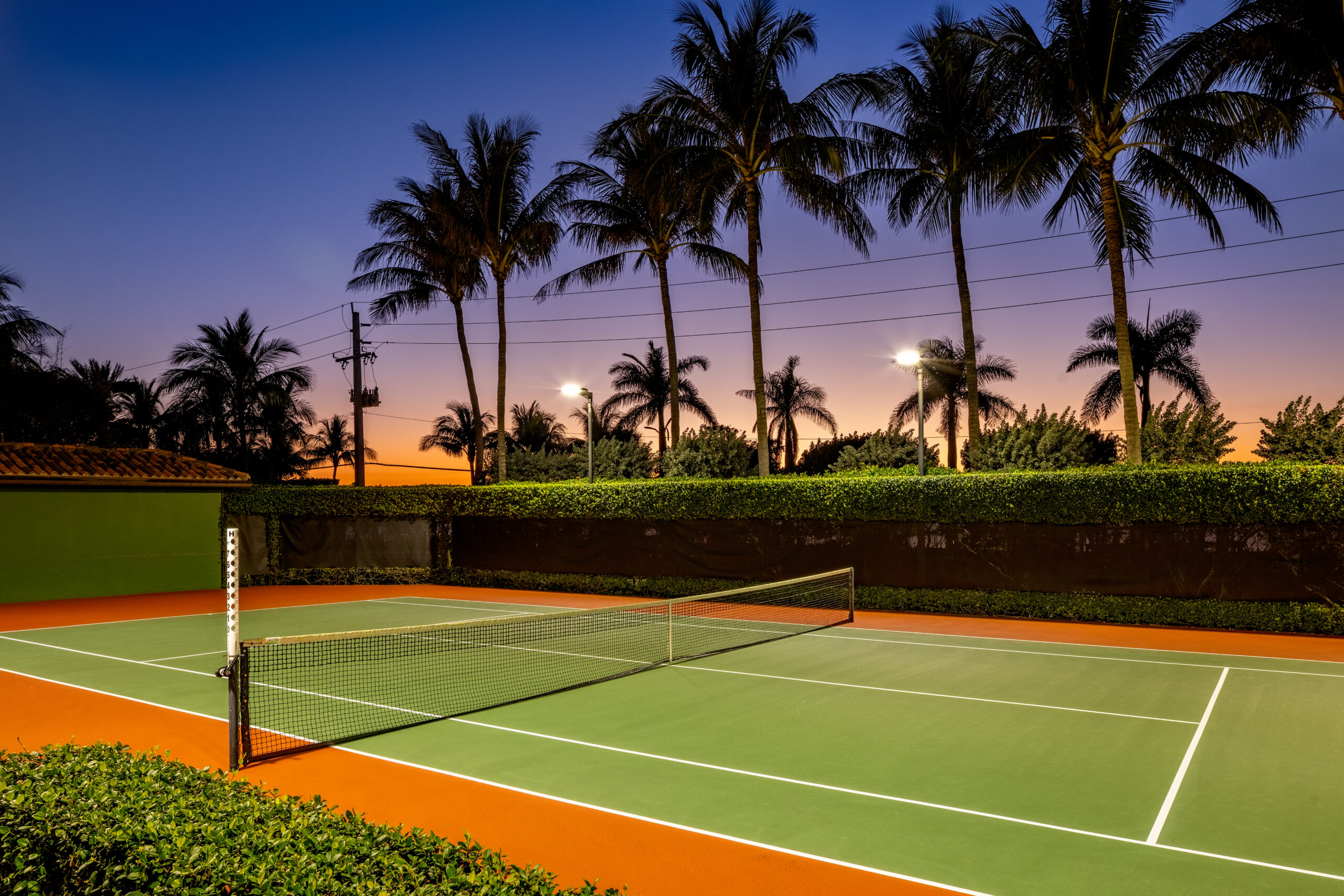
Pole placement matters more than most people realize. Lights positioned incorrectly create glare during serves – one of the most disruptive problems a player can face on a night court. A properly designed system places fixtures along the sidelines at heights between 8 and 12 meters, angled to eliminate blind spots without blinding anyone looking up for a toss.
Beam control is the other major variable. Entry-level fixtures use general-area floodlight optics that scatter light in a wide, symmetrical pattern. Light spills onto neighboring properties, onto fences, into the surrounding landscape. Premium systems use asymmetric precision optics – internal reflectors and specialized lenses that cut light at the court perimeter and direct it onto the playing surface with accuracy.
The right lux standard for a private estate matters too. The International Tennis Federation and the Illuminating Engineering Society define lighting quality in classes. Class III – the residential and club standard – requires a maintained average of 500 to 750 lux with a uniformity ratio of at least 0.7. That is sufficient for tracking a ball moving at over 100 mph without creating the kind of intensity that reads as a stadium to the neighborhood next door. It also requires a Color Rendering Index of 80 or higher, which improves the visual contrast between the ball and the surface — a detail that becomes more important as players age. Class IV systems, which sit below that threshold at 200 to 300 lux, are functional for casual use but are not what most serious players or high-value estates should be running.
Smart controls add the final layer. Modern LED systems integrate with home automation platforms including Crestron, Lutron, and Savant. Owners can program scenes: full intensity for competitive play, 60 percent for practice, a low ambient level for safety or atmosphere. They can set automatic curfews that comply with local ordinances without ever thinking about it again. For dual-court properties, controls allow lighting only the active court, reducing both energy consumption and unnecessary spill light.
The Long-Term Math
The upfront investment looks different once the operating costs are factored in.
A standard 1,000W metal halide fixture runs approximately $500 per year in electricity at average US rates. An equivalent LED operates at 300 to 400 watts and costs $150 to $250 per year. Across a typical six-fixture court running four hours per day, the annual electricity bill under metal halide is around $1,500. Under LED, it falls to roughly $460. That is a reduction of approximately 70 percent.
Metal halide systems also carry maintenance costs that are easy to underestimate. Bulbs operate under high pressure and temperature, degrade quickly – losing around 20 percent of output in the first six months – and require specialized equipment to replace. Annual maintenance costs for a legacy system typically run between $2,000 and $3,000.
Over ten years, the total cost of ownership tells a clear story:
| System Type | Initial Investment | Energy (10 yrs) | Maintenance (10 yrs) | 10-Year Total |
|---|---|---|---|---|
| Legacy Metal Halide | $25,000 – $35,000 | $45,000 – $60,000 | $35,000 – $55,000 | $105,000 – $150,000 |
| Standard LED | $35,000 – $50,000 | $15,000 – $20,000 | $5,000 – $13,000 | $55,000 – $83,000 |
| Premium LED | $50,000 – $75,000 | $18,000 – $25,000 | $3,000 – $5,000 | $71,000 – $105,000 |
A premium LED system costs more upfront than a standard one. It costs the same or less than a legacy system over a decade, and far less in operational friction. The court is always ready. No contractor visits, no 20-minute warm-up times, no bulbs failing mid-match.
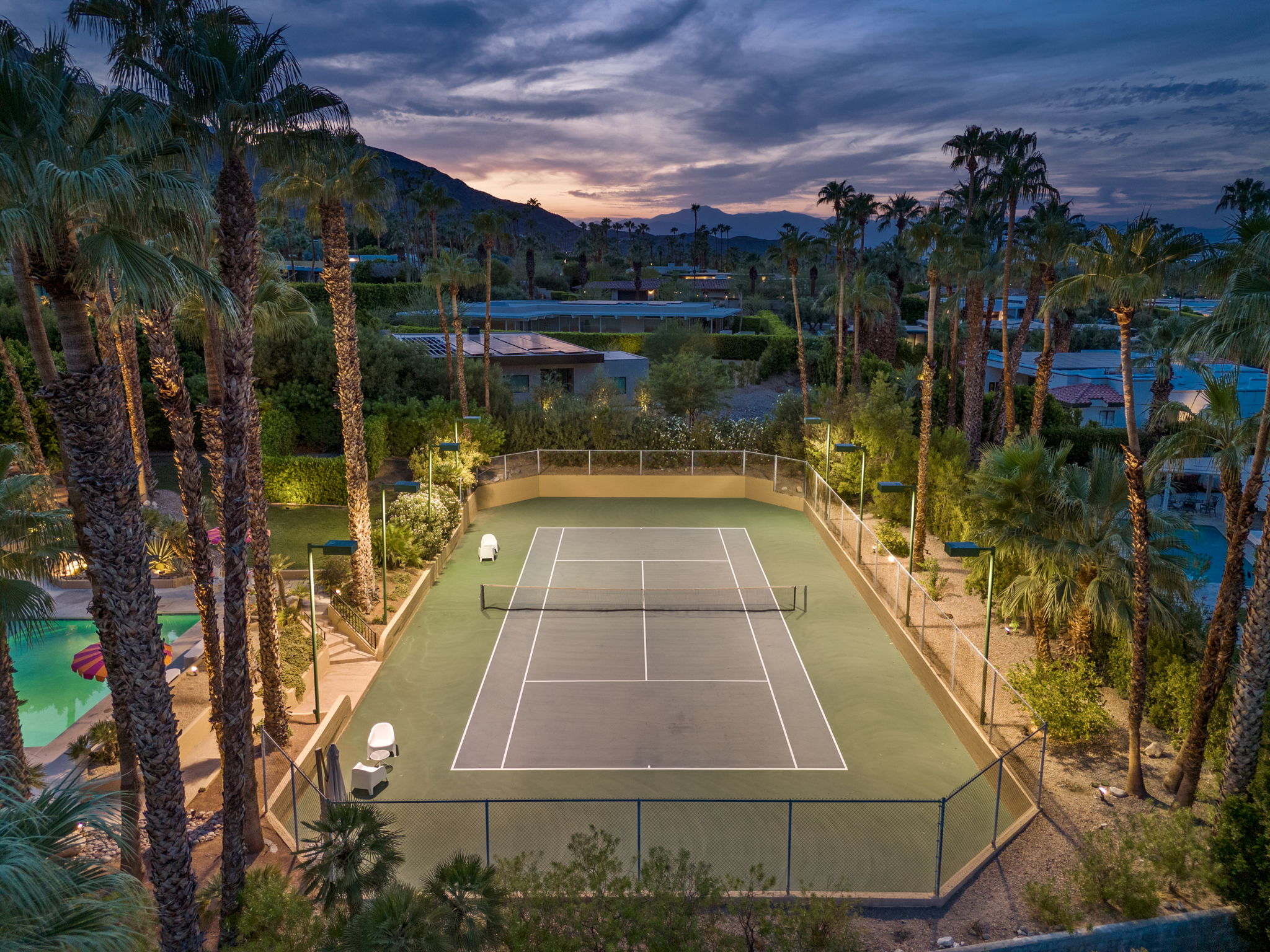
Featured: Oroville Circle Estate | Shannon Weed and Nicolai Glazer, Pacific Sotheby’s International Realty
Where Geography Makes It Complicated
Cost is only part of the equation. In many desirable locations, the real question is whether lighting can be installed at all.
Coastal New York. In some communities in and around the Hamptons, local ordinances have been written in ways that make standard tennis court lighting practically impossible. Restrictions have capped pole heights at 10 feet, limited wattage to 150 watts per fixture, and required full downward-facing dark-sky compliance. For context: a 10-foot mounting height on a full-size court creates hot spots near the poles and dark voids at the center. Achieving even Class IV standards under those constraints requires specialized low-height bollard arrays that are significantly more complex and expensive than a standard installation.
France. In 2018, France passed one of the most comprehensive national laws on light pollution in the world. The Decree of 27 December 2018 applies to both public and private properties and establishes mandatory curfews – typically 10 or 11 pm – after which exterior lighting must be dimmed or extinguished. It also restricts color temperature to no more than 3,000K in most areas, and as low as 2,400K in nature reserves and sensitive ecological zones. The upward light ratio is capped at less than 1 percent, requiring fixtures that produce virtually no sky glow. For a private estate in Provence, the Côte d’Azur, or the Basque Country, lighting a court requires compliance with this law. That means specific fixture types, specific aiming, and sometimes formal documentation.
United Kingdom. Installing floodlights in the UK is classified as “development” under planning law. It requires full planning permission, not just a permit. Applications in Conservation Areas and near heritage sites are particularly sensitive. Authorities commonly require a formal Lighting Assessment demonstrating that the installation will not disturb nesting wildlife, neighboring residents, or the visual character of the area. In some rural and countryside settings, this process results in rejection. Retractable floodlights – systems that lower when not in use – have occasionally been approved as a compromise, though they add significant mechanical complexity and cost.
For a detailed breakdown of how regulations work across different markets and what buyers should verify before committing to a property, we covered this earlier in Tennis Court Lighting Regulations: What Homeowners Need to Know.
Outside the US. For international installations, reliable comparable cost data is harder to source with confidence. What we know from working across markets: Western Europe tends to track US costs or run higher once VAT, planning fees, and engineering documentation are factored in. Labor costs in Southeast Asia and parts of Latin America can run 20 to 40 percent lower, though the availability of qualified sports lighting contractors varies, and the quality risk at the lower end of the market is real.
What Lighting Says About a Property
Looking across the properties in our network, the courts that have been lit thoughtfully tend to share other qualities. Better surfaces. Better fencing. Pavilions or seating nearby. Owners who actually play.
The light is a signal. It tells you something about how seriously the rest of the property was considered.
For international buyers who may arrive jet-lagged, or play during the cooler hours of a European summer evening, a properly lit court is not optional. It is part of the reason the property works.
If lighting is part of how you think about a tennis home, we can tell you quickly whether a specific property and location make that realistic. Sometimes the better path is finding a home where that work has already been done.
Until the next match,
Tennis Homes