December 11, 2025
Before We Dive In
Lighting Up the Court, Without Getting Into Trouble
For many tennis and padel lovers, good lighting is the difference between playing twice a week and playing almost every day. Evenings after work, night sessions with friends, cooler hours in warm climates.
But when you look closer, tennis court lighting is not just a question of “can we add lights” and “how bright should they be.” It is also about local regulations, neighbors, protected landscapes, and how light interacts with the environment around your home.
In some places, floodlights are easy to approve. In others, they are restricted, heavily conditioned, or banned for new courts. Understanding this landscape early makes a big difference for both homeowners and buyers.
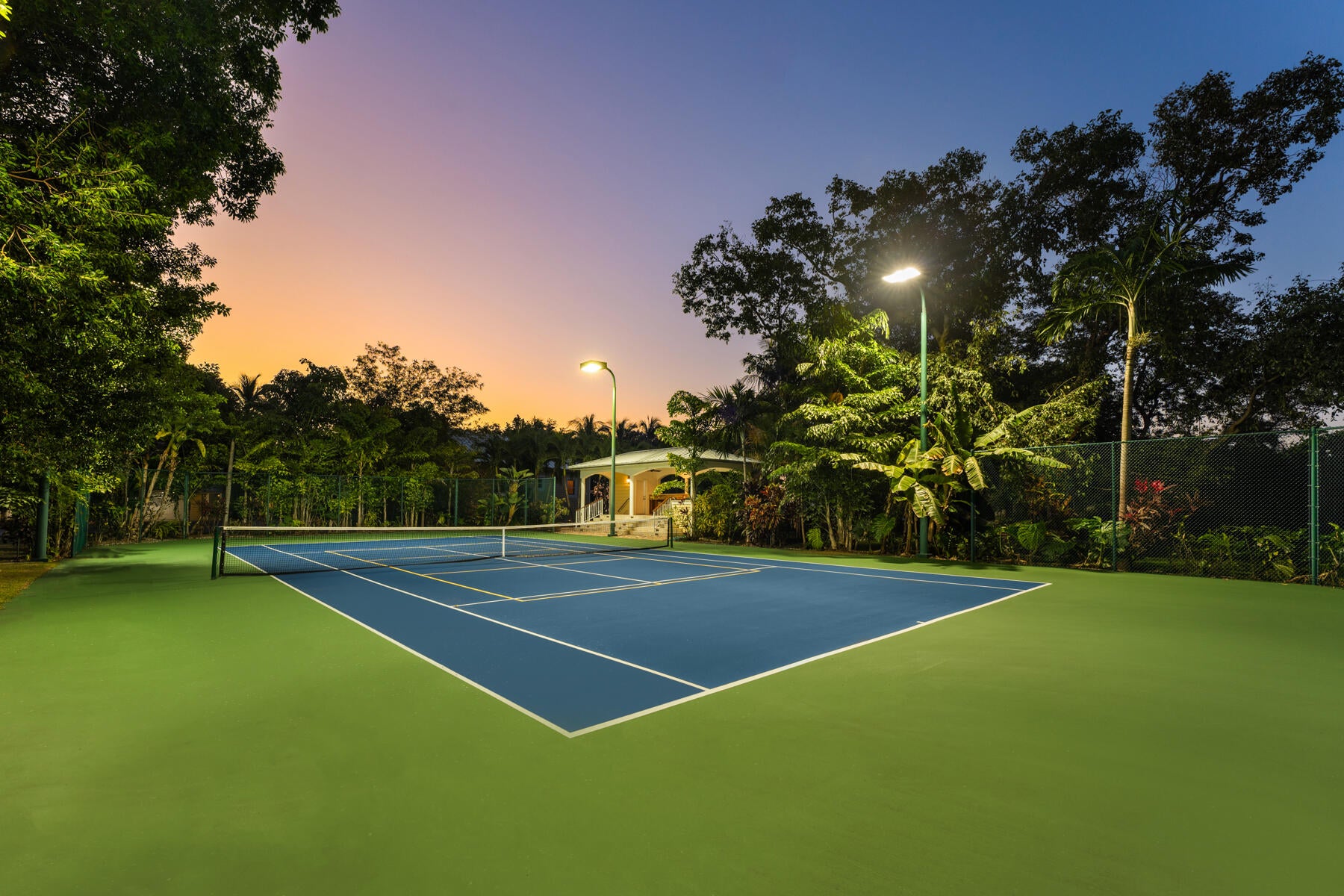
Credit: Leslie Leopold & Cheri Tindall – Ocean Sotheby’s International Realty – 10ak Studios / Palm Tennis Paradise
The Basics
What Good Court Lighting Looks Like
Even if you are not planning a stadium court in your backyard, most quality outdoor courts follow similar guidelines.
For private tennis courts, typical targets are:
Average horizontal illuminance: about 300–500 lux (roughly 30–50 foot-candles) on the playing area.
Uniformity: the light should be even across the court, without dark corners or blinding hot spots.
Mounting height: usually 8 to 12 meters (26 to 40 feet) for full-size courts, depending on local rules.
For padel, the court is smaller and enclosed, so:
Average illuminance is often similar or slightly higher, around 300–500 lux, because walls and glass reflect and absorb light differently.
Poles are usually shorter, 6 to 8 meters (20 to 26 feet), placed outside the glass structure.
Today, almost all new projects use LED fixtures with:
Tight beam control to reduce glare.
Full cut-off or shielded optics to limit upward and sideways spill.
Dimmers and programmable scenes to reduce light during casual practice and full intensity only when needed.
So far this sounds simple. The complexity begins once you bring in regulations.
How Tennis Court Lighting Regulations Typically Work
01
Zoning and Planning
Most municipalities regulate:
Pole height: Often capped around 6 to 10 meters for residential areas. Higher poles may require special approval.
Operating hours: Many areas limit sports lighting to, for example, 10 pm or 11 pm, especially near other homes.
Light spill at property lines: Rules often define a maximum light level at the neighbor’s boundary, commonly in lux or foot-candles.
In Europe and the UK, planning guidance frequently requires a lighting design report with isometric diagrams, lux calculations, and “before and after” comparisons to prove that the installation will not disturb neighbors.
In parts of the United States, especially in upscale residential zones, you may see:
“No new sports lighting” clauses in HOA or community rules.
“Existing lights may remain but cannot be upgraded without permission” conditions.
Design review boards that look at lighting aesthetics as carefully as architecture.
02
Neighbors and Nuisance
Even if your project is technically allowed, complaints can still shut it down or limit its use. Common sources of friction:
Glare into bedroom windows.
Light spill onto terraces, pools, or gardens in the next property.
Noise from late-night matches that go beyond what the community expects.
That is why many luxury properties today use:
Lower glare fixtures with precise optics.
Directional shields to block light toward sensitive views.
Smart controls to set automatic shut-off times and lower light levels during “quiet hours.”
03
3. Environmental and Dark Sky Considerations
In coastal, rural, or protected areas, lighting rules can be even stricter. Examples include:
Coastal zones with nesting sea turtles, where direct or reflected light onto the beach is heavily restricted or banned during nesting season.
Conservation areas, national parks, or rural protection zones with strict limits on upward light and sky glow.
Regions that adopt Dark Sky principles, encouraging fully shielded fixtures, warm color temperatures, and minimal lighting time.
For homeowners, the takeaway is simple. If your property is near the coast, in the countryside, or close to protected land, you should assume that court lighting will be more tightly controlled than in a dense urban setting.
Tennis vs Padel
Tennis vs Padel
From a lifestyle perspective, tennis and padel under lights feel different.
Tennis demands wider coverage and more height. Good lighting makes a big difference on high balls, lobs, and serves. Poorly designed systems can create glare when you look up to serve.
Padel is more contained. The glass and structure help keep light focused on the court, which often makes it easier to design a system that complies with light spill rules, even in tighter properties.
For a luxury home, this can matter. In some markets where new tennis floodlights are difficult to approve, an illuminated padel court, with a smaller footprint and lower poles, can be more realistic.
When Lights Are Restricted or Not Allowed
In many high-end neighborhoods across places like the Hamptons, parts of California, the South of France, or certain UK countryside estates, owners face some version of the following:
“Courts are allowed, but no floodlights.”
“Existing lights are grandfathered, but you cannot add new ones.”
“Lights allowed, but maximum height and strict curfews apply.”
Sometimes these rules come from city zoning. Other times they come from HOA covenants, architectural review boards, or local agreements designed to preserve night-time character.
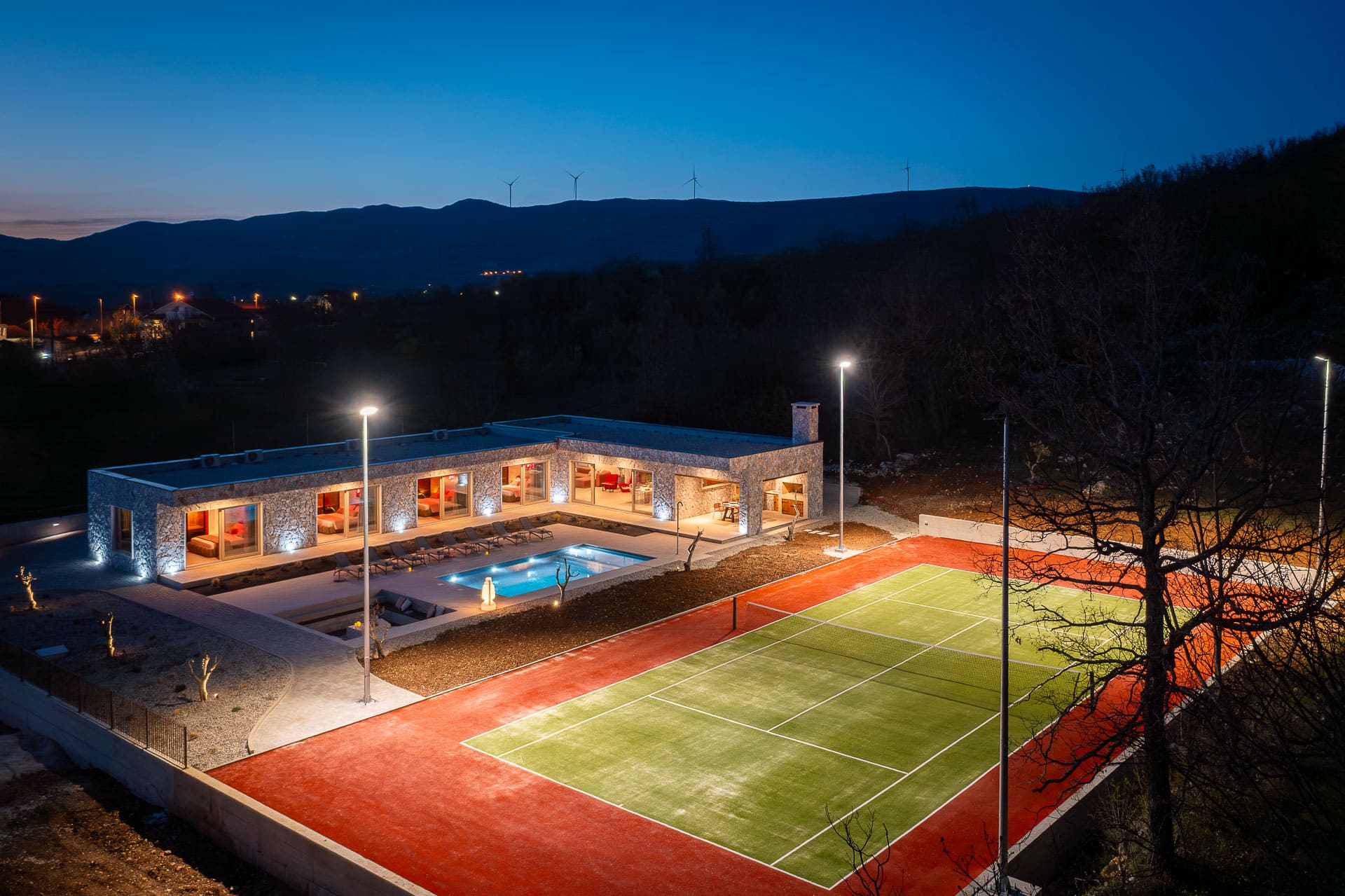
This is why some of the most special tennis homes we feature have:
Beautiful courts with no fixed lights at all, relying on daylight only.
Clever low-level landscape lighting that creates atmosphere without turning the court into a stadium.
Indoor courts or semi-covered structures that solve the weather and lighting issue without external floodlights.
For a buyer who dreams of night tennis, this is a crucial detail to verify before falling in love with a property.
Technical Choices That Make a Difference
If lights are allowed on your property, the way they are designed will shape both your playing experience and your relationship with the surroundings.
Key decisions include:
Fixture type: Modern LED systems reduce energy consumption and offer better control of beam spread and color temperature.
Color temperature: Many residential courts use warmer or neutral tones, around 3000–4000 K, which feel softer and are often more acceptable in sensitive areas than very cold white light.
Control systems: Timers, app-based controls, and dimming help owners adapt brightness to the moment: full power for matches, softer light for casual hitting or kids’ play.
Pole placement and height: Proper placement reduces glare, especially on serves and overheads, and keeps light beams inside your property line as much as possible.
For padel, the geometry is even more precise. Lights sit close to the enclosed structure, so the choice of fixture and aiming is critical to avoid reflections on the glass that disturb players while still keeping neighbors comfortable.
Final Thoughts
How This Affects Buyers of Tennis Homes
If you are looking at a property with a court, or space to build one, lighting should be part of your due diligence checklist.
Questions to ask:
Are there existing lights? If so, when were they installed and under which permission?
Are there any community rules or HOA covenants restricting new or upgraded sports lighting?
Is the property near a protected area, coastline, or rural zone with specific light pollution rules?
If you plan to upgrade to LED, does this count as a “like-for-like” change or a new application?
For many of our clients, the ideal scenario is a home where lights are already approved and thoughtfully designed, or a property where local conditions clearly support a new lighting project without risk of future conflict.
Bringing Your Vision To Life
Our work often starts long before a viewing.
We help buyers and owners understand where lighting regulations are favorable, coordinate with local agents and planners, and curate properties where the court, lighting, and lifestyle all align naturally.
Sometimes the best solution is not to push for new lights, but to choose a home that already has approvals in place, or one with an indoor or semi-covered court that solves the challenge altogether.
If lighting is part of your vision for a future tennis home, we’re here to guide you through what is possible in each market.
Until the next match,
Tennis Homes Team