A question of intention
You would be surprised how many private tennis courts were designed by someone who has never actually played the game. It is more common than you would think — and understandable, given that court placement involves architects, landscape designers, engineers, and the constraints of the land itself. The game does not always get a seat at that table early enough.
The properties where it did are distinctive in a specific way. Not always visually louder or more expensive. Just more considered.
It starts before the first ball is struck
Orientation is one of those details that reveals how early in the process someone was thinking about the experience of actually playing. A court on an east-west axis can put a player serving directly into the sun at certain hours — and anyone who has tried to toss a ball above their head with the late afternoon sun sitting exactly where you need to look knows how much that matters. It is not always avoidable. Topography, lot shape, the geometry of an existing estate — these things impose real constraints. But when the north-south axis is achievable and the decision was made deliberately, you feel it the moment you step on the court.
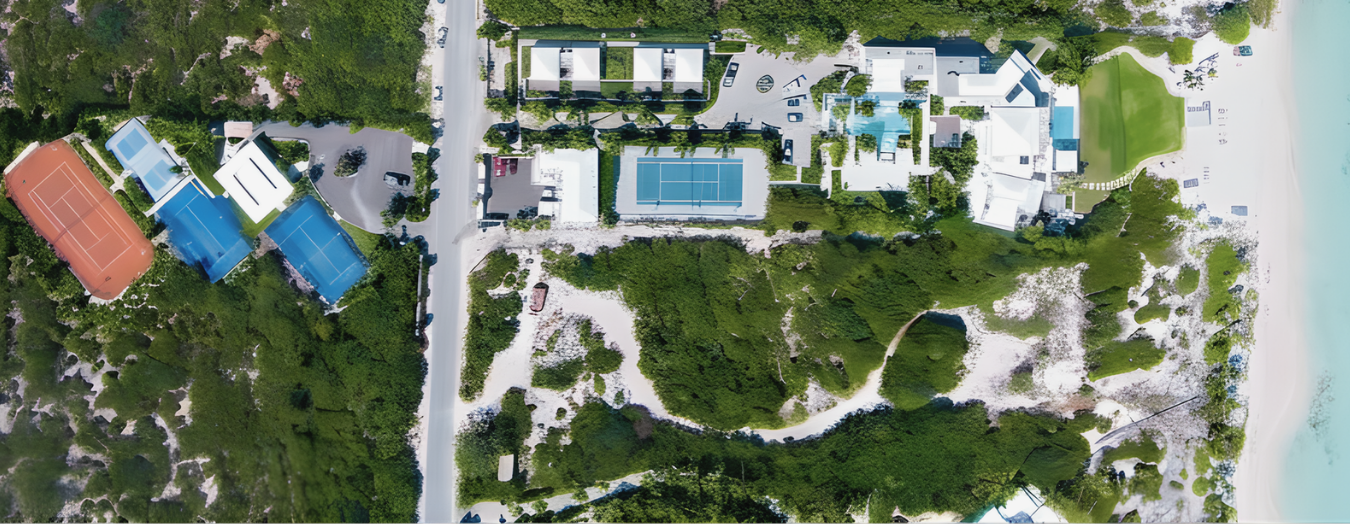
At Triton Villa, a property we have followed closely, the owner built a full sports complex — tennis, padel and pickleball — and if you look at the site from above, the complex courts sit at a different angle from the court adjacent to the main house. That second court follows the geometry of the building, which is a natural and reasonable outcome of how the property was developed. The complex courts follow the sun. Both decisions make sense in their own context. What is telling is that when the owner had the opportunity to build from scratch, orientation was the first conversation — not the last.
Placement is a point of view
On larger estates, the court is often placed at a distance from the main residence. Tucked into the landscape, separated by hedgerow or topography, arrived at rather than immediately seen. There is a logic to this that goes beyond privacy. The court becomes its own destination within the property. You leave the house to go to it. That transition — even a short walk across a garden — changes the experience of playing.
On other properties, the court is fully visible from the living areas. You can watch a match from the kitchen, from the terrace, from the main sitting room. In the right architectural context this can be genuinely beautiful — the court as a living part of the estate rather than a separate facility, something that animates the view and keeps the energy of the property connected across its full footprint.
Neither is superior. What matters is whether the relationship between the court and the house was considered at all — and in most of the properties we find most compelling, it clearly was, regardless of which direction that thinking went.
The pavilion, the terrace, the rock
In the most considered properties, there is always somewhere the court was designed to be experienced from when you are not playing. A pavilion, a covered terrace, a natural ledge. Sometimes the entire architecture of the main house. This is where design moves beyond the technical and into something harder to define but immediately felt — the court not just as a place to play but as a place to be.

Panorama Tennis Estate
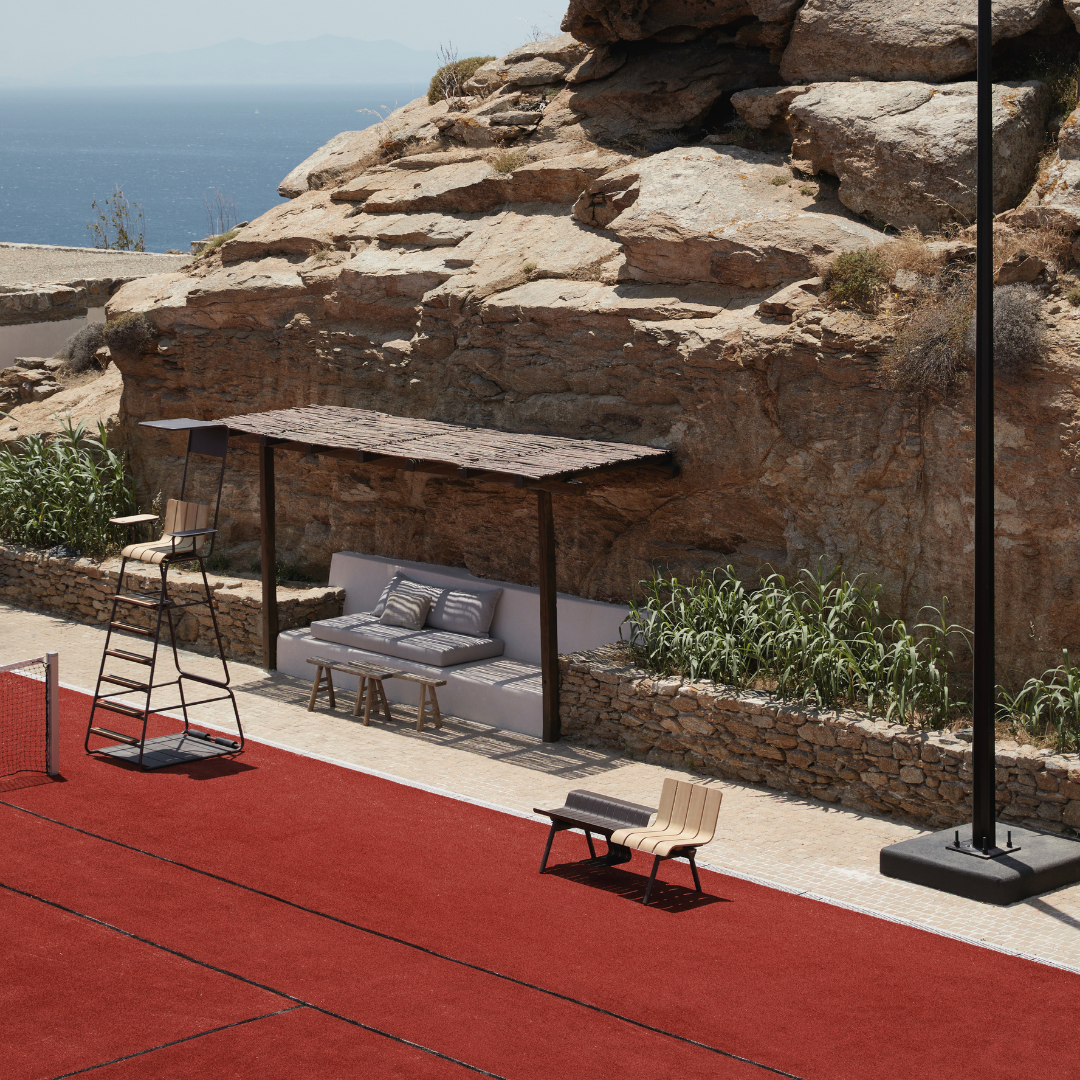
In Mykonos, that place is a simple reed canopy built against a formation of ancient rock. Red surface, whitewashed stone walls, a wooden umpire chair as the only vertical gesture apart from the rock itself. Nothing was added that did not need to be there. The restraint is the design and the result is a court that feels less like a residential amenity and more like something that grew out of the island.
Represented by Despina Laou, Sotheby’s International Realty
The Point Dume Legacy Estate
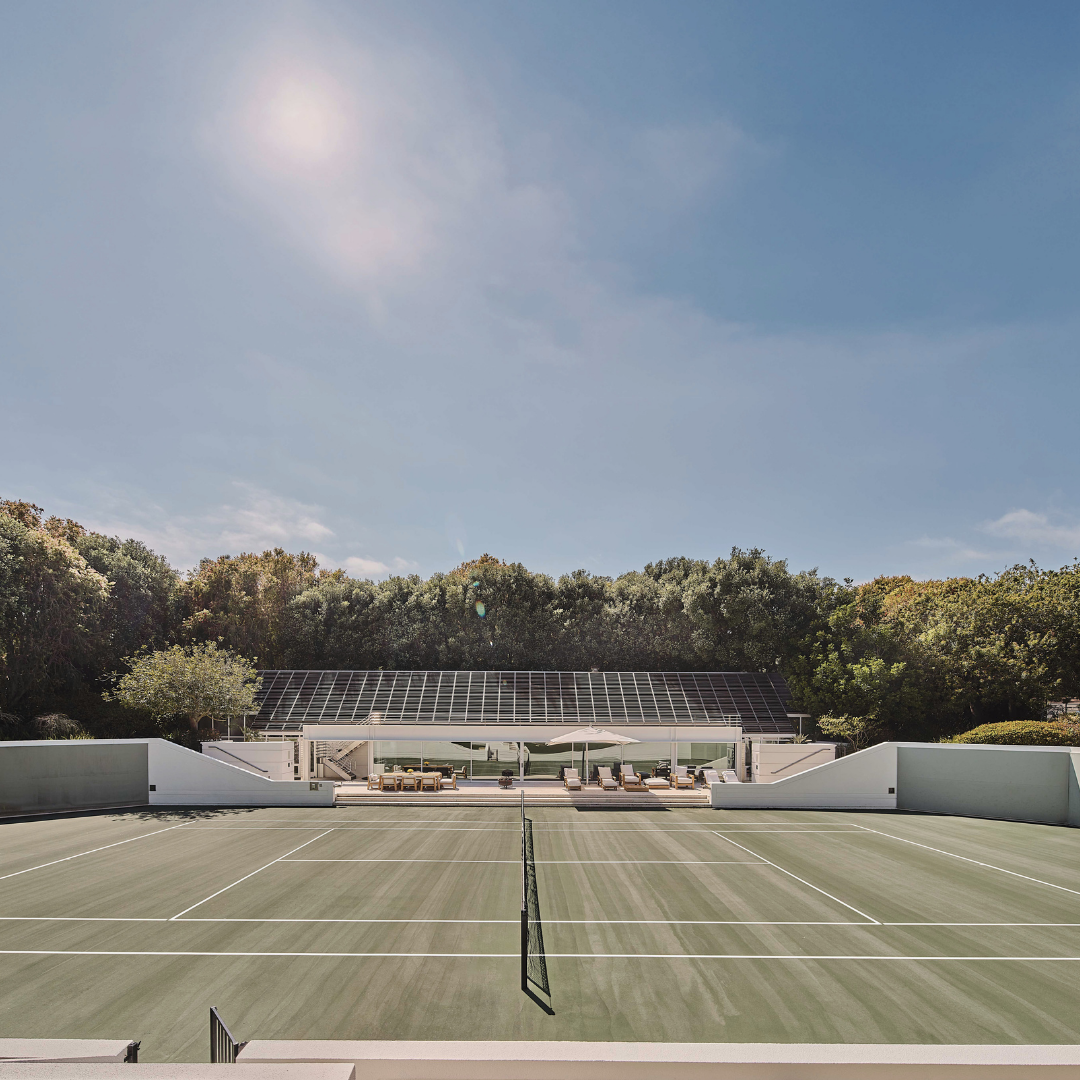
In Malibu, the approach is architectural rather than elemental. The court is sunk below grade, hard surface, with symmetrical walls on either side leading to a full glass pavilion at the far end. The effect is of a private stadium — contained, precise, completely deliberate. The pavilion does not just provide shade or seating. It closes the composition. Without it the court would be a different object entirely. With it, the whole thing holds.
Represented by Chris Cortazzo, Compass
Villa Palm Seco
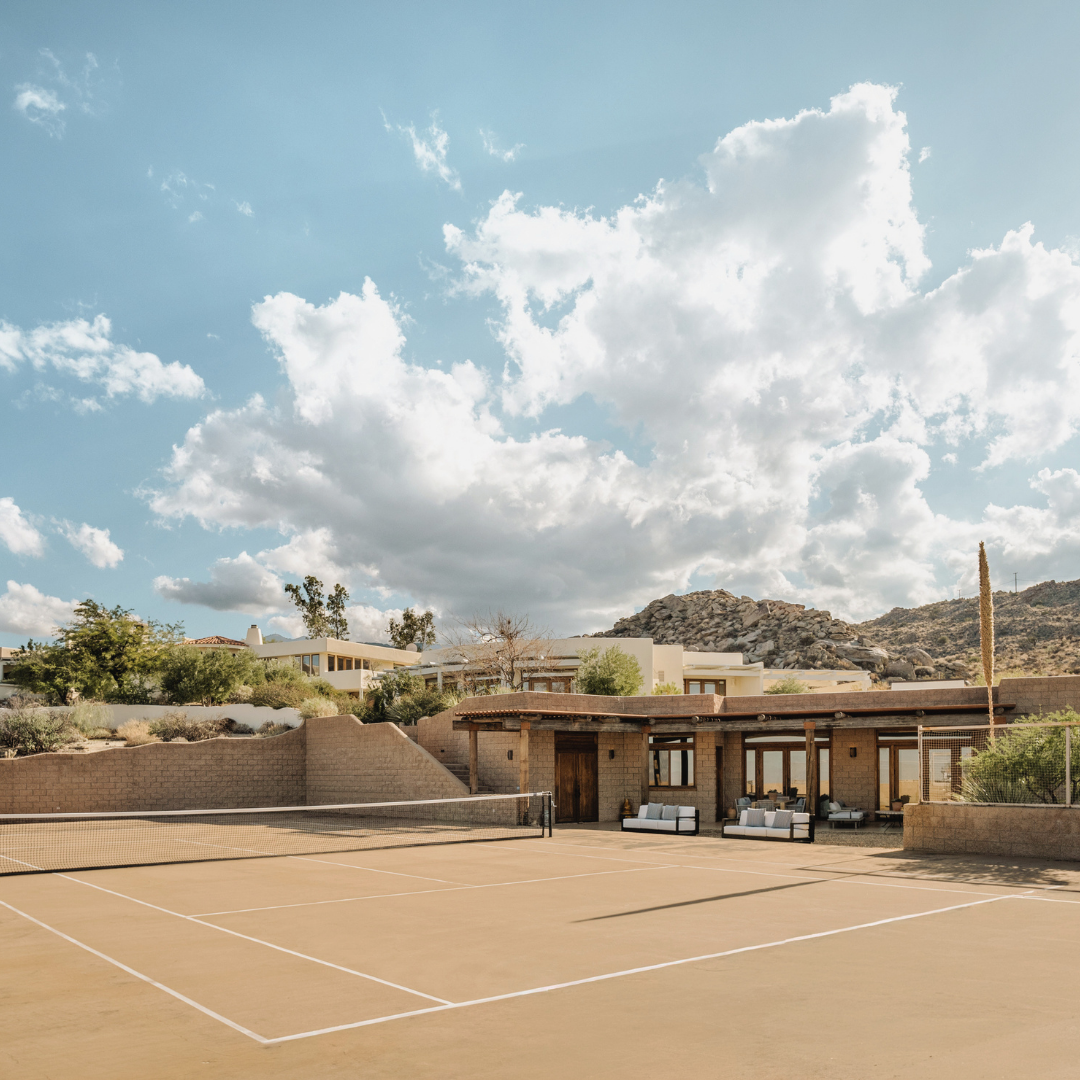
In Mountain Center, the pavilion is built from the same adobe and timber as the estate itself. Open-sided, covered, oriented to the court and the desert mountains that frame the back of the property. You come off the court and stay in the landscape rather than retreating from it. The material continuity between the pavilion, the surrounding walls, and the main house means the entire court complex reads as one coherent thing, not several elements assembled near each other but a single idea executed consistently.
Represented by Michelle Schwartz and Adrienne Herkes, The Agency
Deerhaven Gardens
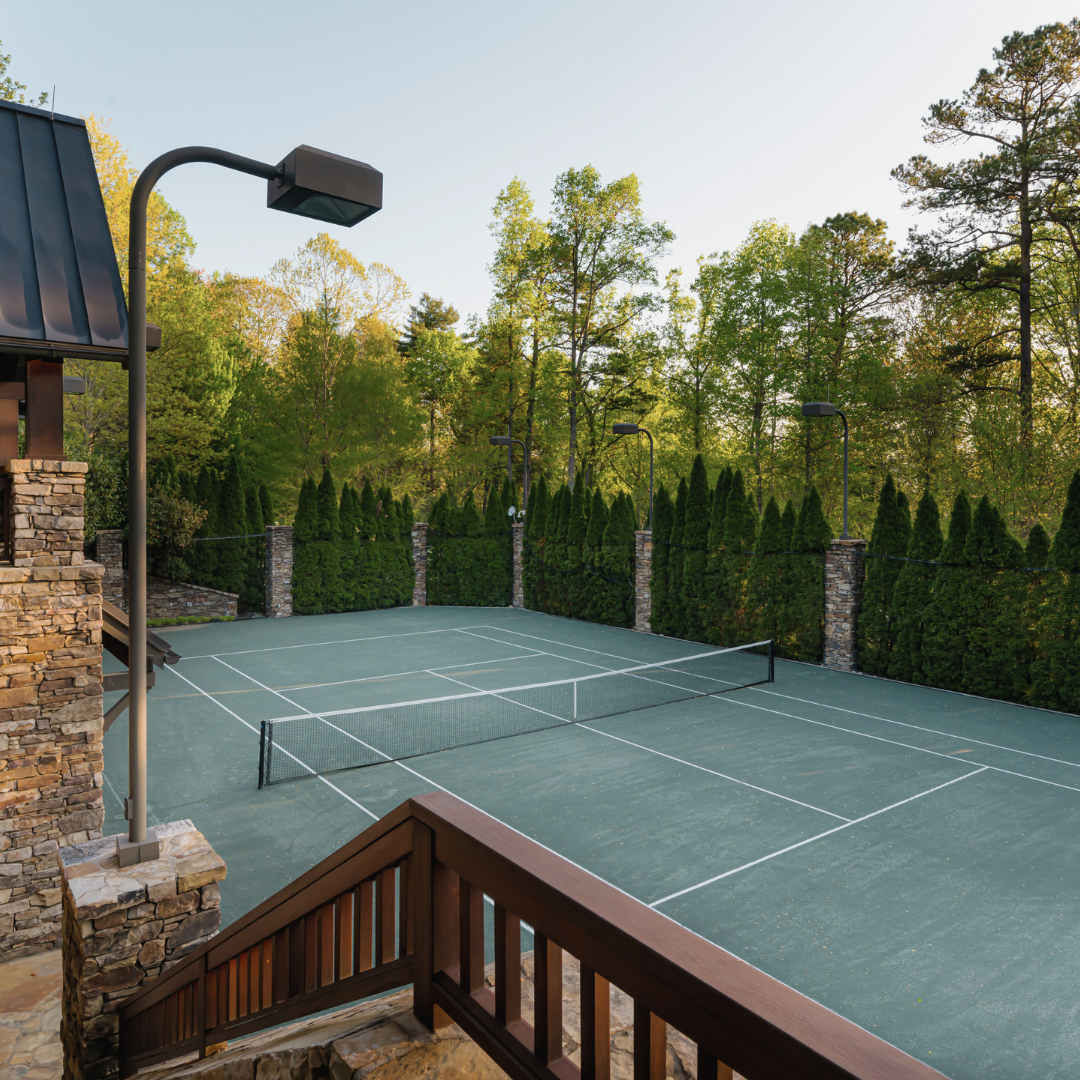
In Asheville, North Carolina, the pavilion is two stories — a stone base that doubles as the court's retaining wall, with a timber-framed upper level opening out to the forest behind it. The structure does not sit beside the court as an afterthought. It anchors the entire composition, the same stacked stone continuing from the pavilion walls along the full perimeter. The surrounding trees are part of the design in the same way the rock face is in Mykonos — not landscaping added around the court but the natural setting the court was placed inside.
Represented by Alec Cantley, Sotheby’s International Realty

Cohesion is the thing
What connects these properties is not a shared aesthetic. The Mykonos court and the Malibu court have almost nothing visually in common. What they share is cohesion — the sense that the court belongs to the same conversation as the rest of the estate. That the materials speak to each other. That the proportions were considered together. That someone asked not just where the court goes but what it would feel like to arrive there, to play there, to sit in the shade of the structure beside it and watch someone else play.
When that thinking is present, you feel it before you ever pick up a racket.
Until the next match,
Tennis Homes